
Is the “Early Mover Advantage” Dead in the AI Era? – Insights from GITEX Dubai 2025
A Different Kind of Revolution
The halls of GITEX Global Dubai 2025 buzzed with one word: AI.
Every booth, every startup, every conversation somehow circled back to artificial intelligence. From enterprise software vendors to brand-new startups, everyone had an “AI-powered” label on their product.
But as exciting as it all looked, one thing stood out — the market is flooded with sameness.
The so-called “AI revolution” is real, but for many companies, it’s becoming more of a race to catch up than a sign of innovation. At Buinsoft Technology, we spent days exploring booths, talking to founders, and studying solutions. And our biggest takeaway was simple yet shocking:
In the AI world, being early doesn’t mean being ahead anymore.
The End of the Early Advantage
Traditionally, in tech and startups, being the first to market meant having an edge — more visibility, investor interest, and market share.
But in 2025, AI is rewriting that rulebook.
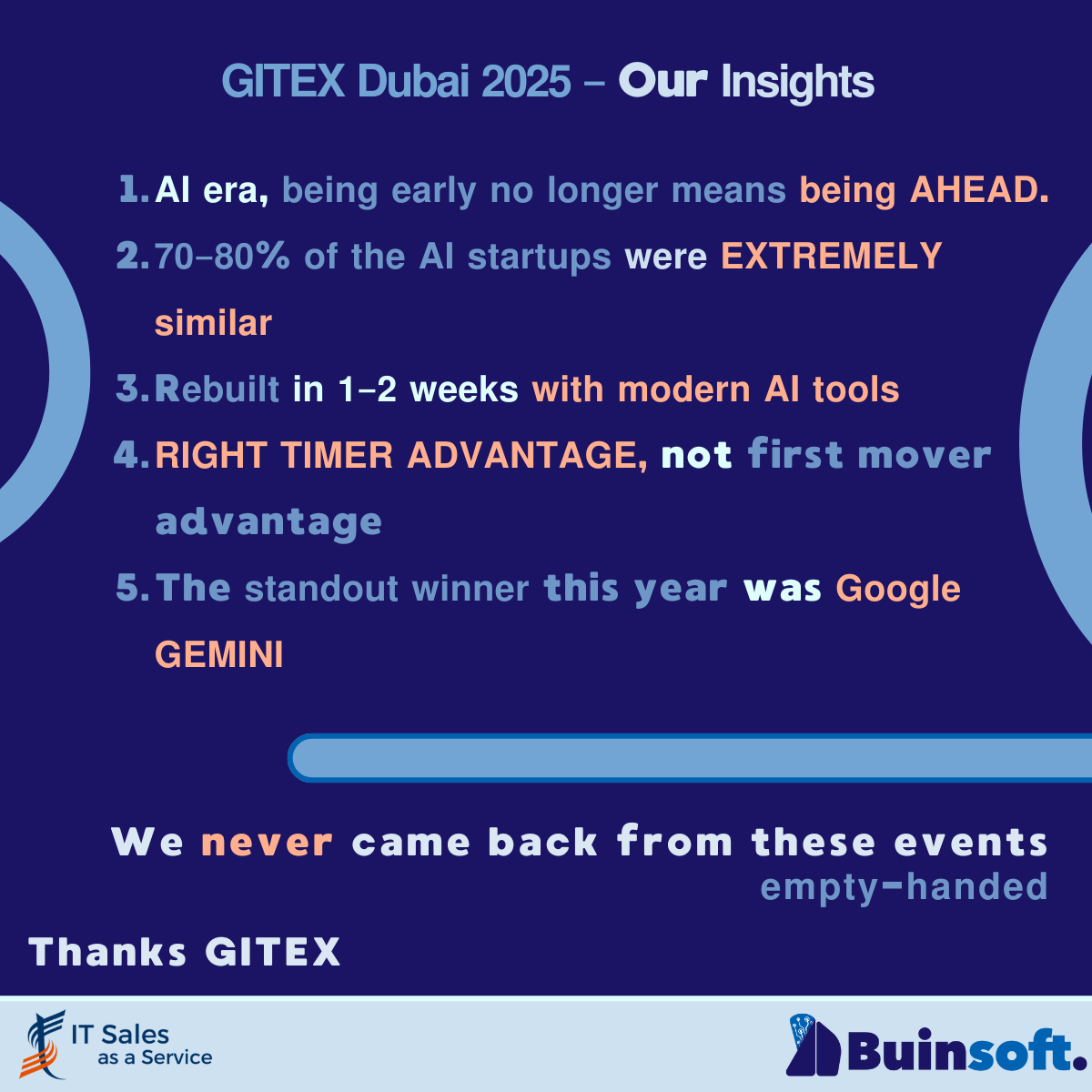
At GITEX, we observed that 70–80% of AI startups were offering nearly identical solutions.
Most revolved around familiar ideas — chatbots, voice assistants, WhatsApp or Telegram automation, or basic email handling. They looked impressive, but under the hood, many of these products used the same underlying models and frameworks.
Some of these startups have raised millions of dollars in funding. Yet, the technology they were built on just one or two years ago is now obsolete. What used to take months to develop can now be rebuilt in a week or two using the latest AI tools and open-source frameworks.
This means that being early might no longer be a strength — it could actually be a liability.
When Speed Outruns Innovation
The pace of AI development is unprecedented.
A company can release a product today, and within weeks, someone else can recreate — or even improve — it with fewer resources and newer models.
We’ve experienced this firsthand at Buinsoft.
Earlier this year, while working on a client project in Dubai, a new AI platform launched that completely changed the approach to the same problem. Overnight, months of design and planning lost relevance. Not because the work was bad — but because the world simply moved faster.
This constant disruption makes it harder than ever to rely on traditional innovation cycles. The “build it once and scale it” model doesn’t apply to AI. Instead, survival depends on constant adaptation and continuous rebuilding.
From First Mover to “Right Timer” Advantage
So, what replaces the early mover advantage?
We believe the new success factor in AI is “right timing.”
It’s no longer about who enters the market first — it’s about who adapts the fastest to the new tools, models, and shifts happening almost weekly.
The winners of the AI race won’t be those who were first to announce their chatbot or data assistant. It will be those who can rethink, rebuild, and redeploy solutions the moment technology evolves.
In this sense, flexibility is the new innovation.
Agility — not legacy — determines survival.
Why Many AI Startups Look (and Feel) the Same
Walking through the AI halls of GITEX felt like déjà vu.
The same features, same dashboards, even similar marketing slogans. Everyone had an “AI copilot,” a “chat assistant,” or an “automation brain.”
Why is this happening?
Because the barrier to entry in AI development has dropped dramatically.
Open-source libraries, cloud-based APIs, and model-as-a-service platforms like OpenAI, Google Gemini, and Anthropic’s Claude have made it incredibly easy to launch something “AI-based” in weeks.
The result?
Many companies are building on the same base technology — fine-tuned differently, wrapped in new branding, but fundamentally identical.
That’s why 2025 might become the year we see a wave of consolidation or even mass shutdowns among small AI startups.
Not because they failed to innovate, but because innovation got cheaper and faster, making their “unique” products replaceable.
AI is Not SaaS
Another realization from GITEX is that AI isn’t a traditional SaaS game.
In SaaS, it was all about recurring value and long-term stickiness. Once a customer was onboarded, switching costs were high. But in AI, switching is frighteningly easy.
If a better model appears tomorrow, you can migrate your backend in days.
If another startup releases a stronger tool, customers can move instantly — no data lock-ins, no vendor loyalty.
In this new world, retention depends not on contracts, but on constant value renewal.
That’s why businesses in AI must keep evolving their offerings every few weeks — not every few quarters.
The Bright Side: Opportunity in the Chaos
Despite the saturation, GITEX also showed an incredible level of energy and creativity.
Yes, many solutions were similar — but that also means the barriers to innovation are lower than ever.
It’s a fantastic time for small, fast-moving teams to compete with big players.
If your company understands AI fundamentals and moves quickly, you can easily replace older, slower systems. The cost of experimentation is low — and the potential rewards are huge.
And amidst all the noise, one company stood out to us: Google Gemini.
The roadmap and capabilities shared during the event were on another level. We already integrate Gemini into several Buinsoft projects, and its evolution is pushing the limits of what’s possible with AI-driven business automation.
Networking Still Matters
Beyond the technology, GITEX reminded us of something timeless:
Relationships still drive opportunities.
The event was crowded, vibrant, and full of ideas.
For us, it was not just about discovering trends but about connecting with clients, partners, and innovators who are shaping what comes next.
We left with new collaborations, exciting project ideas, and plenty of lessons — proving once again that GITEX is always worth attending.
Final Thoughts
AI is moving faster than any technology before it.
The companies that thrive will be those who learn, rebuild, and adapt continuously.
Being first is no longer the ultimate goal.
In this new landscape, timing, adaptability, and agility are the real advantages.
At Buinsoft, we’ve embraced that philosophy — building flexible, AI-driven solutions that evolve as fast as the tools behind them.
Because in 2025 and beyond, it’s not about being first.
It’s about being ready for what’s next.