

WHAT is VECTOR database?
It is a comprehensive examination of its conceptual foundations, technological infrastructure, and also its application areas. Vector storage systems are infrastructures that store data as multidimensional numerical representations and enable fast similarity-based searches among this data. The purpose of this study is actually to analyze, at an academic level, the technical components of vector storage as well as its operating principles and future development areas. Vector storage essentially becomes a special data storage system that stores data in the form of multidimensional numerical representations called vectors. In fact, vector storage is a specialized system designed to store embedded vectors. Due to the unique characteristics of vector embeddings, vector storage systems are actually a specialized design that distinguishes them from traditional data storage systems. A vector database is a special database designed to store, manage, and search high-dimensional vector embeddings. The fundamental capability of a vector database is semantic similarity, which identifies conceptually similar data points rather than analyzing keywords. It stores both dense and sparse vector embeddings generated by machine learning models in order to provide fast similarity search and retrieval. The vector created by the database positions related items closer to each other, allowing the system to rank results based on relevance.
VECTOR STORAGE
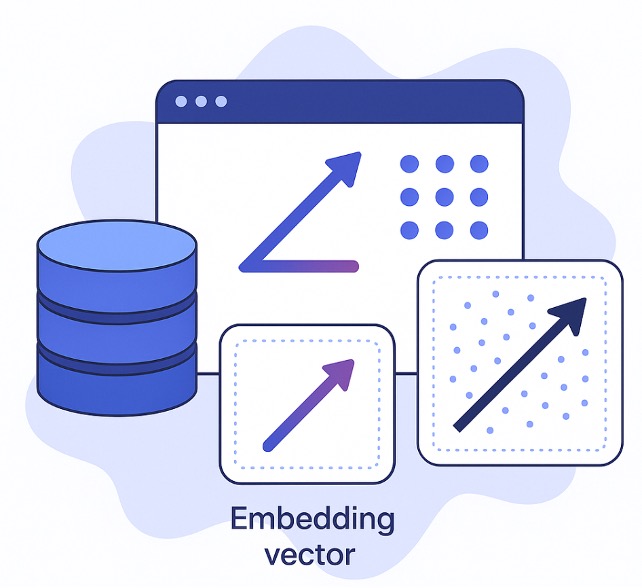
It is a specialized data system that represents data in numerical dimensions. These vectors are typically produced by machine learning models that represent the semantic content of audio files, videos, and images. These representations are called embedding vectors.
WHAT IS THE EXPLANATION OF AN EMBEDDING VECTOR?
Embeddings, which actually form the basis of vector storage, are the mathematical representation of complex data in a transformed form. For example, pen, notebook, school, teacher—these all receive vector values close to the same semantic cluster. It is important to note that embedded representations generated by one provider’s model will not be understood if transferred to another provider. For example, an embedding produced by model X will not be compatible with another provider’s model.
HOW VECTOR STORAGE WORKS
In a vector database, data is first processed during data collection. Raw data such as text, images, or video is taken in. Embedding creation occurs when a machine learning model generates a vector for the data. The vector is then stored—that is, recorded in the vector database. An example of such a system is Chroma. To explain the connection between vector databases and vector storage systems, one must first understand vector databases, then examine their relationship and the resulting technical complexities. Finally, it is necessary to address what to consider when evaluating vector databases for your projects.
CORE FEATURES OF VECTOR STORES
For high-dimensional data, vector embeddings typically consist of hundreds or thousands of dimensions and create unique challenges for both storage and retrieval. For specialized search, unlike traditional databases that use exact-match queries, vector-based databases use nearest-neighbor search with specific distance metrics. From an efficiency perspective, traditional databases are generally inefficient when working with vector data, because vector stores are built from scratch to efficiently manage the storage and retrieval of high-dimensional vectors.
Limited flexibility
To optimize performance, vector stores typically focus on supporting high-dimensional and numerical data and sacrifice some versatility found in general-purpose databases.
Simplified schema designs
Compared to general-purpose databases, vector stores usually have less flexible schema designs and prioritize structures optimized for vector data.
Specialized query support
Rather than supporting a wide variety of query types, vector stores are optimized primarily for the nearest-neighbor retrieval operation performed on vector data.
VECTOR DATABASE
On the other hand, a vector database forms a more comprehensive system that incorporates the capabilities of both vector databases and vector stores while providing initial features and functionality. The key features of a vector database include:
Broader query support
Vector databases allow more complex queries that combine vector similarity searches with traditional database operations.
Vector data
These systems link stored vectors to structured data using robust and complex query mechanisms, similar to those found in relational databases.
Advanced vector indexing
Many vector-based databases include advanced indexing techniques to improve the performance of both vector-based and non-vector-based queries.
WELL-OPTIMIZED VECTOR SYSTEM
Adding high-dimensional schema support and nearest-neighbor search capabilities to a database is not necessarily an extremely complex project. However, optimizing these features for production use is a significant challenge. A production-ready vector database must include efficient storage components. Efficient and fast storage means the system must be able to quickly insert, update, and delete vector data even when working with large datasets.
Support for multiple distance metrics
Different applications may require different similarity measurements; therefore, a versatile vector store should support various distance metrics.
This explains in detail why vector storage has taken on a critical role in modern data management. In short, vector storage, unlike traditional databases, makes it possible to evaluate data based on semantic meaning, offering significant advantages for solutions that support both search and analytical systems. With the increasing volume of unstructured data, the importance of vector storage technologies is expected to grow further. Currently, approximately 80% of the data produced in the digital ecosystem is considered unstructured. Traditional data storage systems fail to capture semantic relationships within such data.