

HOW ARE SOFTWARE OPERATIONS BECOMING AUTONOMOUS IN 2026?
In fact, a comprehensive examination is carried out on how AI-supported systems reshape the lifecycle. As of 2026, in the field of software development, distribution and operational processes have radically transformed thanks to AI-based automation and autonomous agent mechanisms. In this article, the technological, methodological and organizational components of how software operations become autonomous in 2026 are systematically examined. Since the mid-2020s, the software industry has undergone a major transformation, and operational processes requiring high labor such as continuous monitoring, maintenance, deployment and troubleshooting have increasingly become systems managed by artificial intelligence. This transformation actually means not only an increase in the level of automation but also that software systems gain the ability to evaluate themselves specifically, make decisions, and optimize themselves. By 2026, most software operations have become autonomous agents that perform real-time analysis. The aim of this article is to examine how this autonomous transformation emerged, both technically and meteorologically.
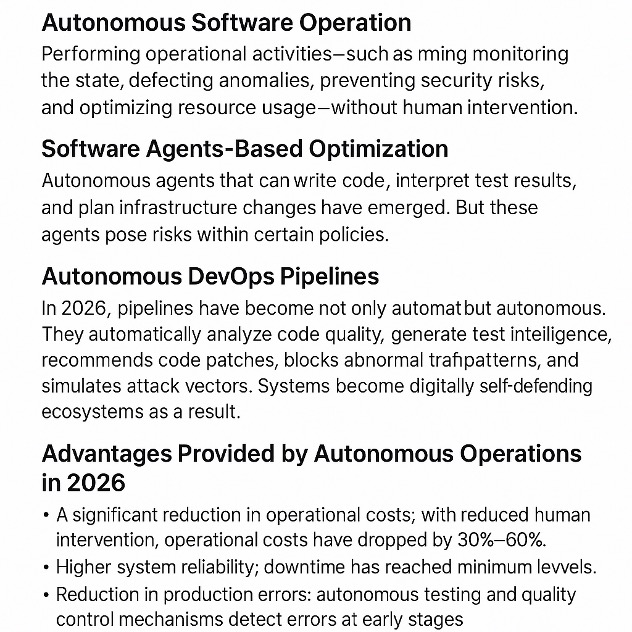
AUTONOMOUS SOFTWARE OPERATION
Autonomous software operations mean performing operational activities—such as monitoring the state, detecting anomalies, preventing security risks, and optimizing resource usage—without human intervention.
SOFTWARE AGENTS-BASED OPTIMIZATION
Autonomous agents that can write code, interpret test results, and plan infrastructure changes have emerged. But these agents pose risks within certain policies.
AUTONOMOUS DEVOPS PIPELINES
In 2026, pipelines have become not only automated but autonomous.
They automatically analyze code quality, generate test data themselves, and determine deployment strategies in real time. Thanks to these mechanisms, they cease to be human-supervised and become human-controlled but machine-driven.
AUTONOMOUS SECURITY
In 2026, security operations also became autonomous. AI detects security vulnerabilities, analyzes threat intelligence, recommends code patches, blocks abnormal traffic patterns, and simulates attack vectors. Systems become digitally self-defending ecosystems as a result.
ADVANTAGES PROVIDED BY AUTONOMOUS OPERATIONS IN 2026
A significant reduction in operational costs: with reduced human intervention, operational costs have dropped by 30%–60%.
Higher system reliability: downtime has reached minimum levels.
Reduction in production errors: autonomous testing and quality control mechanisms detect errors at early stages.
Improvement in incident response time: most incidents are resolved before they reach a human.
Significant increase in developer productivity: developers, freed from operational workload, focus on innovation.
EMERGENCE OF NEW ROLES AND COMPETENCIES
With the technologies that became widespread in 2026, new roles emerged. Technological transformation does not eliminate human labor but redefines it.
NEW MODEL OF HUMAN–MACHINE COLLABORATION
The human has moved into a high-level control role, guiding the system’s strategic decisions. The machine, meanwhile, takes on the tasks of execution, analysis, and decision support.
CHALLENGES AND LIMITATIONS
Despite being advanced in 2026, autonomous software operations still have some issues. These include AI biases, ethical decision-making outcomes, organizational resistance, and the lack of the data volume required for full autonomy.
Thus, as of 2026, software operations have become significantly autonomous thanks to artificial intelligence, autonomous agents, and advanced AI architectures. This transformation is not only a technological innovation but also reshapes software engineering culture, role definitions, and business models. In future years, fully autonomous, self-optimizing software ecosystems are expected to become the norm.
As of 2026, the technological, methodological, and organizational transformation that makes it possible for software operations to be largely conducted by autonomous structures has been examined from an academic perspective.
WHAT IS THE CONCEPT OF AN AUTONOMOUS SYSTEM?
An autonomous system is defined as a system that can perceive its own state, interpret the data it obtains, produce output, and take action when necessary without human intervention. In the modern software ecosystem, autonomy is examined through four components, which become the fundamental pillars of software operations in 2026.
SOFTWARE AGENTS AND AUTONOMOUS DECISION-MAKING MODEL
In 2026, software operations are managed not only by static rules but also by autonomous software agents. These agents constantly analyze environmental data, perform policy-based evaluations, produce risk scoring, and select the most appropriate action. This process has become a new engineering discipline at the intersection of decision theory, reinforcement learning, natural language interpretation, and distributed systems engineering.
FUTURE PERSPECTIVE (2026–2034)
According to academic projections, after 2026:
Fully autonomous software ecosystems, natural-language-managed operations platforms, self-managing infrastructures, and architectures that minimize human oversight become a perspective redefining software engineering.
The year 2026 has become a critical turning point where AI-driven software operations evolve from human-centered processes to guided autonomous ecosystems.
The relationship between AI and autonomy targets decision theory and reinforcement learning. Agent-based architecture supports both autonomous software agents, multi-agent systems, and inter-agent communication and decision sharing. Autonomous security requires attention to AI-supported security patches. With the reduction of human error, autonomous mechanisms have reduced manual-operation-based mistakes by up to 90%.